Battery health belongs to a specific vehicle and test
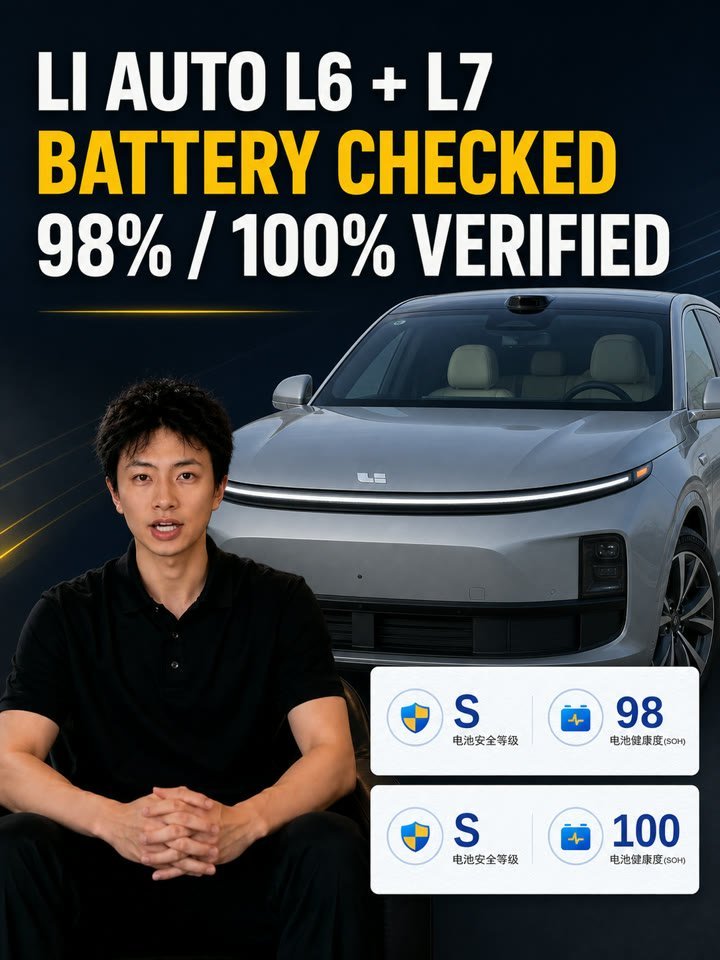
The supplied third-party reports recorded 98% battery health for one Li Auto L6 example and 100% for one L7 example. These figures describe the tested units at the time and under the method used. They are not a promise for every L6, L7 or used EV.
Read the report context, not only the percentage
Match the report to the VIN, test date, mileage and vehicle. Check who issued it, which diagnostic method was used and whether warning codes or abnormal degradation were recorded. A percentage without vehicle identity and test context is weak purchasing evidence.
Battery evidence is one part of a used-car inspection
A used-EV review should also document body condition, accident or repair indicators, cabin wear, tires, glass, equipment operation and visible warning messages. Where necessary, add a third-party inspection and written condition report before payment and shipment.
Build the requirement before selecting the car
Send the model, budget, acceptable mileage, condition requirements, quantity and destination port. State the battery evidence you require and whether repairs are acceptable. The supplier can then source units that fit the written criteria instead of trying to justify a vehicle after it has already been selected.
Read battery evidence together with the rest of the vehicle
A displayed state-of-health percentage is only one input. Ask which device or diagnostic system produced it, when the test was run, the odometer at the time, battery temperature, state of charge and whether faults were present. Preserve the report or screen recording linked to the exact vehicle. The percentages shown in the source material describe those inspected Li Auto units; they should not be treated as a guarantee for another car or as a universal threshold.
Combine battery evidence with charging behaviour, warning history, underbody and battery-case inspection, service records, accident and water exposure checks, tire condition and a controlled road test where possible. Also confirm what battery warranty, account services and remote functions remain usable in the destination market. A strong purchase file states what was tested, what was only observed and what could not be verified before export.
Make the purchase decision from combined evidence
Before approving a used EV, create a one-page decision record. Identify the exact vehicle and seller, compare mileage with service and diagnostic records, summarize battery evidence, note accident or paint findings, record warning lights and road-test observations, list remaining uncertainty and assign a person to resolve each open item. Set an acceptance rule before negotiating the final price so a strong battery number does not distract from structural, electronic or documentation risk.
The final record should conclude approve, approve with written conditions, request another inspection or reject. Conditions may include a repeated diagnostic test, correction of a warning, replacement of a consumable, provision of a missing document or a price adjustment. This decision trail is especially useful for dealer inventory because it creates a repeatable standard across vehicles instead of relying on one inspector's memory.