
Start with the named place, not the abbreviation
FOB and CIF only become useful when the quotation names the relevant port and states what is included. In Zebra Motors quotations, domestic transport to Nansha, Shanghai or Ningbo and container-loading charges may be shown as separate lines. Land delivery to Khorgos is quoted separately. The written quotation controls the actual commercial scope.
CIF pays freight and insurance, but is not landed cost
Under standard CIF, the seller arranges agreed freight and insurance to the named destination port. Customs clearance, taxes, destination charges, storage and inland delivery remain separate unless the quotation expressly includes them.
Cost payment and risk transfer are not the same
CIF can include payment of freight to destination while cargo risk transfers earlier, commonly when the goods are loaded at the port of shipment under Incoterms 2020. The contract and insurance documents must state the applicable boundary. Do not assume the seller carries every risk until arrival merely because freight was prepaid.
Why CIF may not be simple arithmetic
In Zebra Motors' described process, arranging transport and insurance before arrival uses working capital and adds financial exposure. CIF service may therefore involve a different payment arrangement, higher deposit or availability limited to established clients. Exact conditions belong in the quotation and contract; no fixed percentage is assumed here.
Match final-payment evidence to the trade term
In Zebra Motors' process, an FOB balance check can include a warehouse-entry video showing the VIN-linked vehicle at the agreed Chinese loading port. For CIF, the buyer checks the draft bill of lading and packing list, matching model, quantity and VIN to the order. A draft bill is not an issued original bill, and a warehouse video is not proof of ownership.
Ask for an itemized quotation
Provide the model, quantity, destination country and port, then ask for the named origin and destination, loading charge, freight, insurance scope, excluded destination costs, payment schedule and required evidence. That creates a comparison buyers can actually audit.
Use one comparison sheet for every quotation
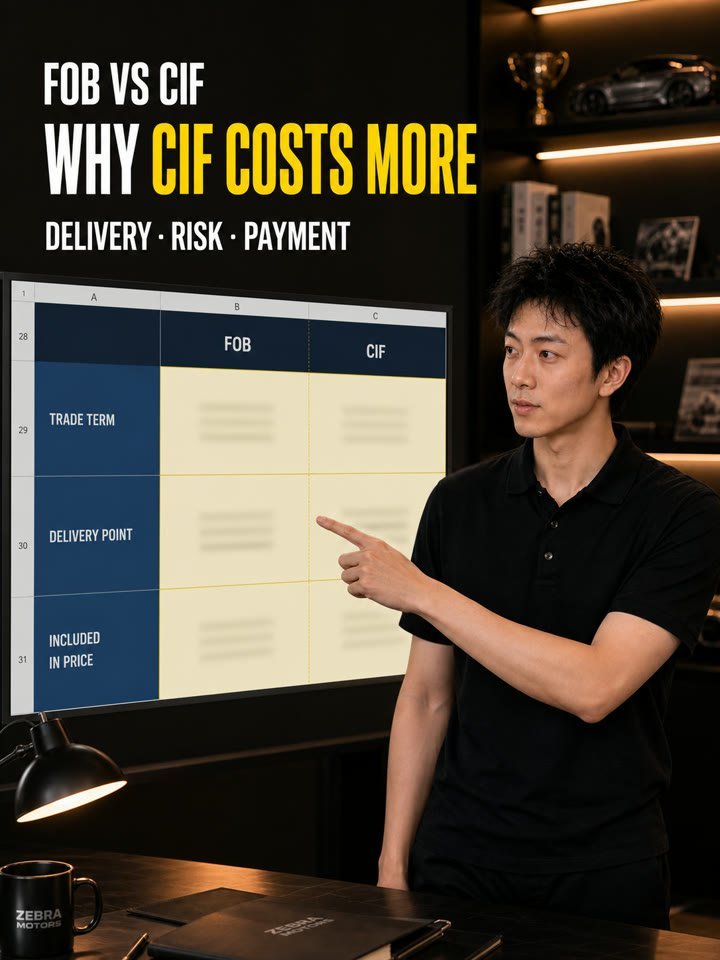
Put each quotation into the same columns: exact vehicle, quantity, condition, named origin point, named destination port, inland transport, export handling, loading, ocean freight, insurance, destination charges, payment milestones, validity period and evidence required before each payment. Leave a cell blank when an item is not stated instead of assuming it is included. This turns an attractive total into a commercial scope that can be checked line by line.
The order should repeat the selected Incoterms rule with the named port and version, for example Incoterms 2020, while the payment clause lists the documents or visual evidence for each milestone. Also record who controls booking changes, demurrage, storage and destination clearance. These questions do not make every risk disappear, but they expose differences before two offers are called equivalent.
Choose the term from control, capability and cash flow
FOB may suit an importer that already controls a reliable freight forwarder, understands the origin-port handover and wants to manage the main carriage. CIF may suit a buyer that wants the seller to arrange freight and insurance to the named destination port, provided the buyer understands the insurance level and the costs still payable after arrival. Neither term is automatically cheaper or safer; the answer depends on who can manage each stage more reliably and how much capital each side must commit.
Before choosing, ask who books the carrier, who receives schedule changes, who handles insurance claims, which document releases the cargo and what happens if the vehicle misses the planned sailing. Put those answers beside the price. A term becomes useful only when the people, evidence and exception process are as clear as the cost.